


Share

10 min read

Senior Content Manager
Content specialist in office design and build.
-
Paddington’s case as an office location is built on connectivity. Heathrow is 15 minutes away by Heathrow Express and 25 minutes by the Elizabeth line. That’s closer than from anywhere else in central London.
But the transport story goes further: Great Western Railway services to Reading, Bristol and Cardiff, four Underground lines and the Elizabeth line’s extended eastward reach into the City and Canary Wharf. In short, Paddington is one of the most comprehensively connected office addresses in London. That combination shapes how things run every day for businesses with international clients or distributed teams.
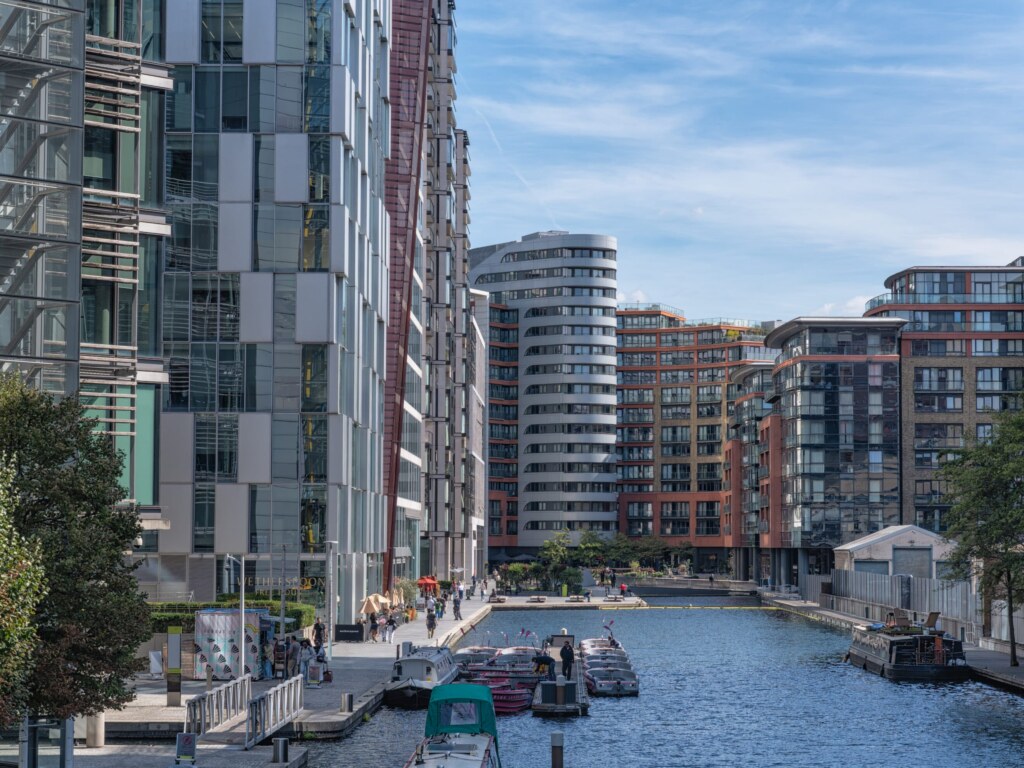
The working environment has changed significantly over the past two decades. The regeneration of Paddington Basin and Paddington Central has produced a waterside campus with cafes, restaurants, a public amphitheatre, canal-side walkways and a quality of public realm that older parts of W2 never had.
There are two distinct settings. To the north, the canal-side campuses of Paddington Central and Merchant Square. To the south, the station-side buildings of Eastbourne Terrace. Each offers a different working environment, and the choice between them matters.
This guide covers what you need to know about office space in Paddington: the streets, transport, building types and five of the area’s most notable buildings.
Table of contents:
-
Working in Paddington
Paddington’s working environment is shaped by its geography. The station draws a commuter catchment that extends well beyond the Underground network. It reaches into Berkshire, Oxfordshire, Wiltshire and South Wales via Great Western Railway, and across west and central London via the Elizabeth line. That breadth makes Paddington easily accessible to a wider range of team members than most central London submarkets.
The canal-side setting of Paddington Basin and Paddington Central gives the working environment a character that’s rare in central London. The Grand Union Canal runs through the heart of the area with buildings at Merchant Square, The Point and the Sheldon Square campus overlooking the water or sitting directly next to it. That setting creates a daily working experience that employees and businesses consistently cite as a reason for choosing and staying in Paddington over more conventional office districts.
The Eastbourne Terrace strip immediately outside the station is a different proposition. There’s less waterside character, but more immediate convenience. Buildings here are steps from the station entrance, which suits businesses whose people are constantly in transit. The two settings coexist within a few minutes’ walk of each other, and most Paddington occupiers benefit from both.
The occupier profile has diversified considerably. Marks & Spencer, Orange (now part of EE/BT) and Vodafone were early anchors at Paddington Central. Virgin Media O2, AstraZeneca, Microsoft, PwC and a growing range of technology and pharmaceutical businesses have followed. The area’s Thames Valley transport connections make it a natural choice for businesses whose second major site is Reading, Swindon or Bristol.
-
Location, transport and key streets
Paddington covers the W2 postcode, with the active office market concentrated in two clusters: Eastbourne Terrace and the Paddington Basin/Paddington Central campus. From there, the submarket extends north towards Little Venice and the canal, and east towards Bayswater.
-

-
Key streets and clusters include:
- Eastbourne Terrace runs the length of the station’s south side, with Landsec’s 20 and 30 Eastbourne Terrace providing refurbished Grade A offices directly opposite the Elizabeth line entrance. Businesses here are as close to the station as it’s possible to be.
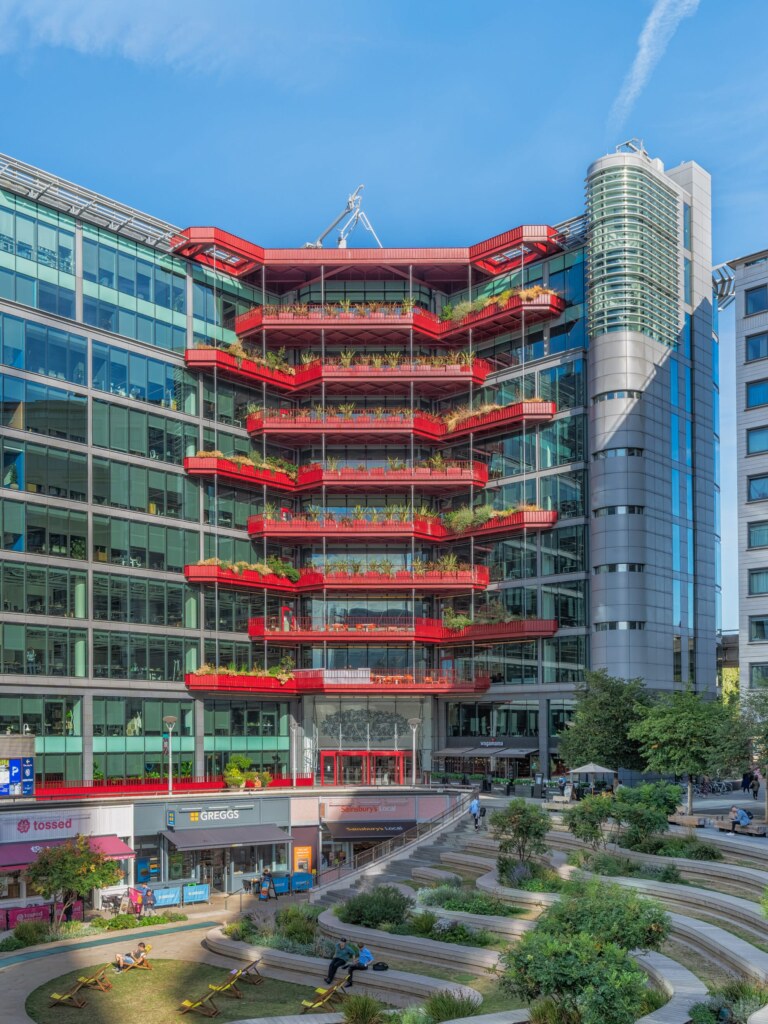
- Sheldon Square and Kingdom Street form the commercial core of Paddington Central, British Land’s 11-acre campus. 3 and 4 Sheldon Square and the Kingdom Street buildings sit around a central public square with restaurants, a gym and a programme of events that bring the campus to life.
- Merchant Square and North Wharf Road are the western part of the Basin, developed separately from Paddington Central and offering a more distinctly canal-side character. 5 Merchant Square and The Point are the most notable buildings here.
- Grand Union Canal towpath links the two main clusters and runs west towards Little Venice – one of the more pleasant short walks from any London office, and part of the daily working experience in Paddington.
-

-
Transport connectivity at Paddington is exceptional:
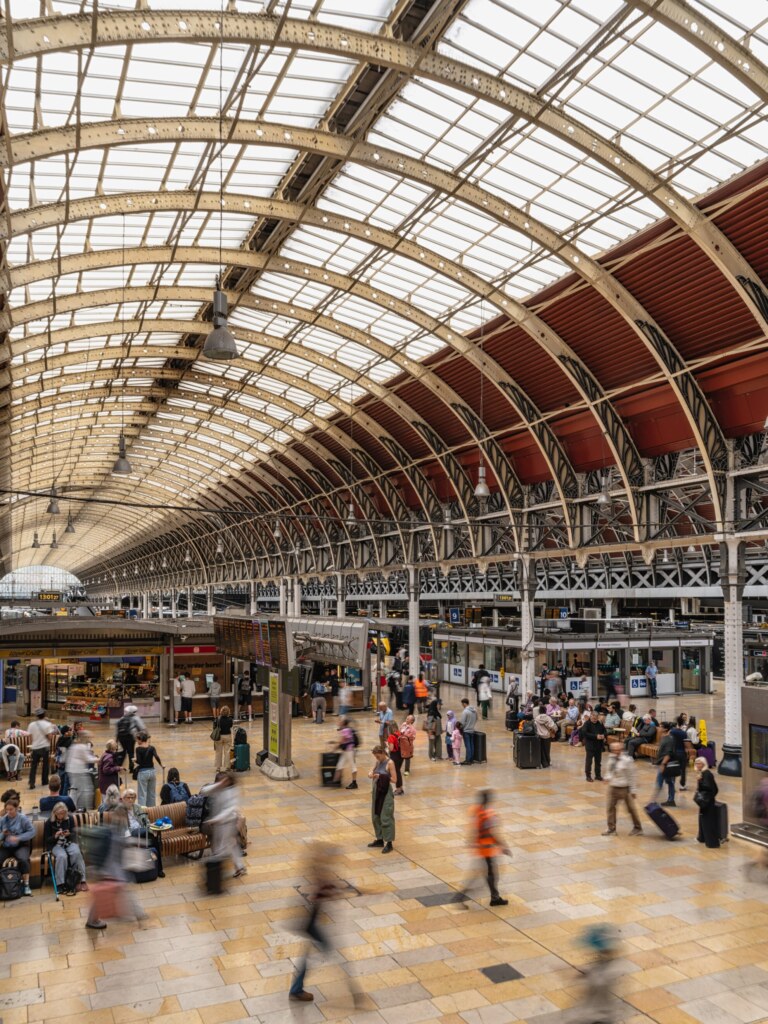
- Paddington station serves the Elizabeth line, Bakerloo, Circle, District and Hammersmith & City Underground lines, and Great Western Railway services to Reading, Bristol, Cardiff and the Thames Valley. Heathrow Express puts Terminal 5 15 minutes away, or 25 minutes on the Elizabeth line.
- The Elizabeth line has widened Paddington’s commuter catchment eastwards, connecting Canary Wharf in 17 minutes, Liverpool Street in around 12 minutes and the City directly without the need to change.
- Great Western Railway services to Reading, Swindon, Bristol and Cardiff make Paddington the most practical base for businesses with operations or significant client relationships in the Thames Valley and the South West.
- Edgware Road station (Bakerloo, Circle and District lines) is within walking distance of Merchant Square and the northern part of the Basin, providing an alternative interchange for those coming from the east or south.
-
-
Types of office space in Paddington
Paddington’s office market spans a range of building types and tenure options. Here’s a closer look at the main categories:
-
Station-side refurbishments
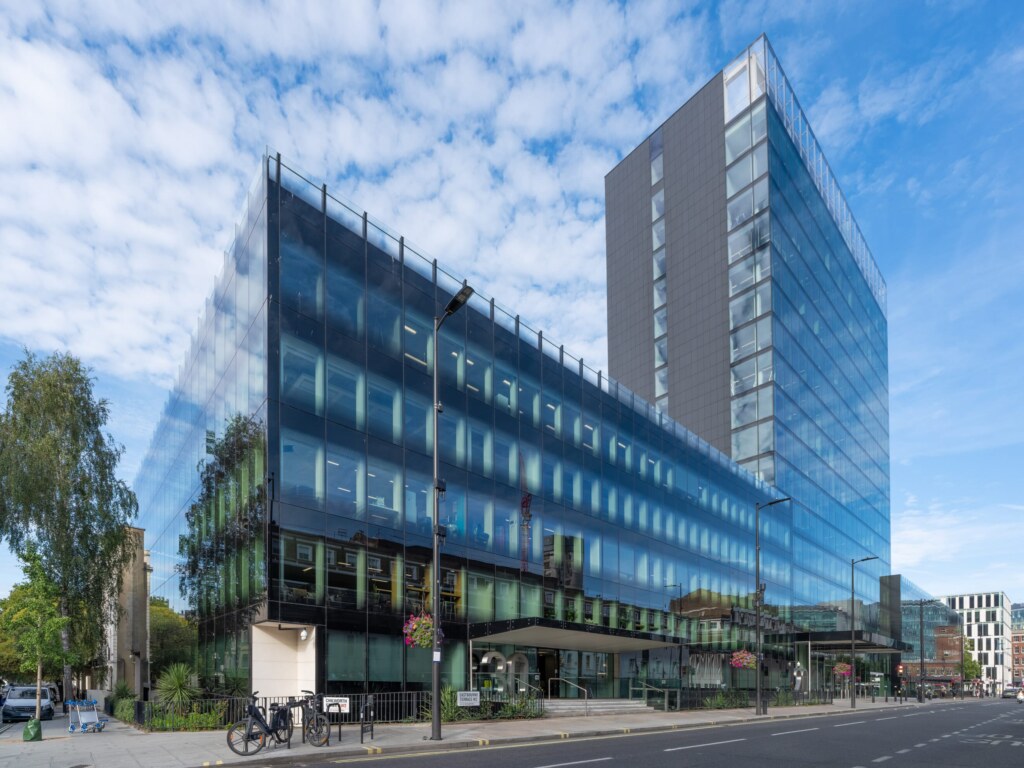
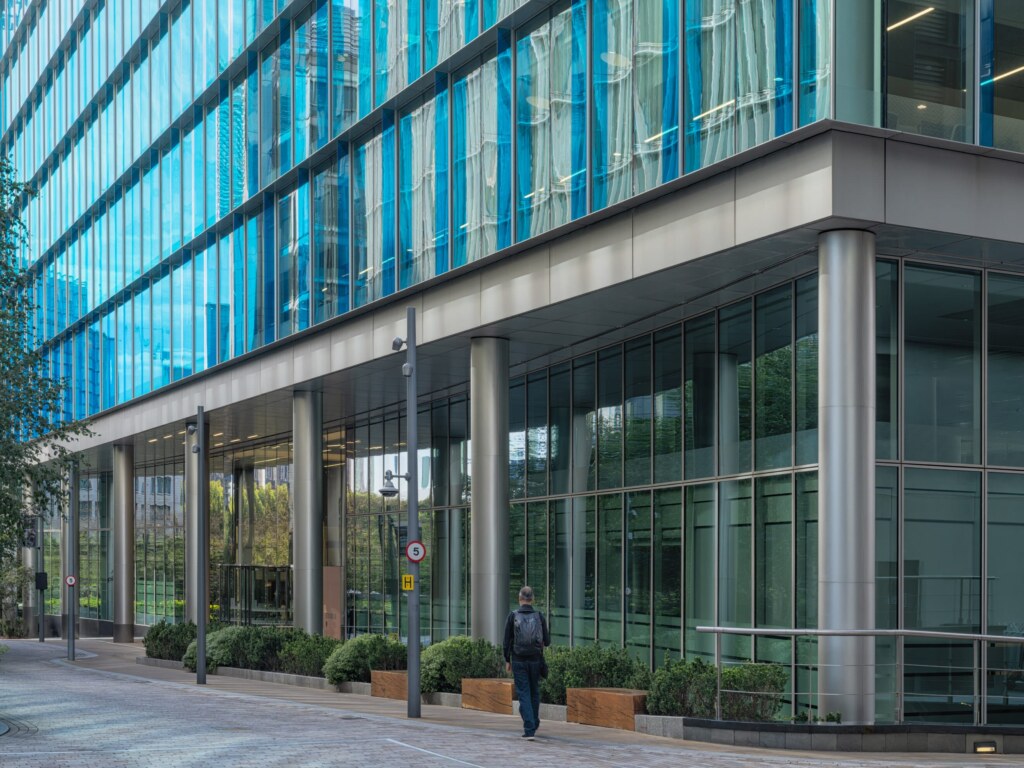
The Eastbourne Terrace buildings offer refurbished offices that prioritise transport convenience above all else. These buildings are directly opposite the station entrance, benefitting from BREEAM Excellent credentials and renewable electricity. They suit businesses whose people are constantly moving, whether that’s across to Heathrow or connecting to the Elizabeth line network.
-
-
Campus Grade A
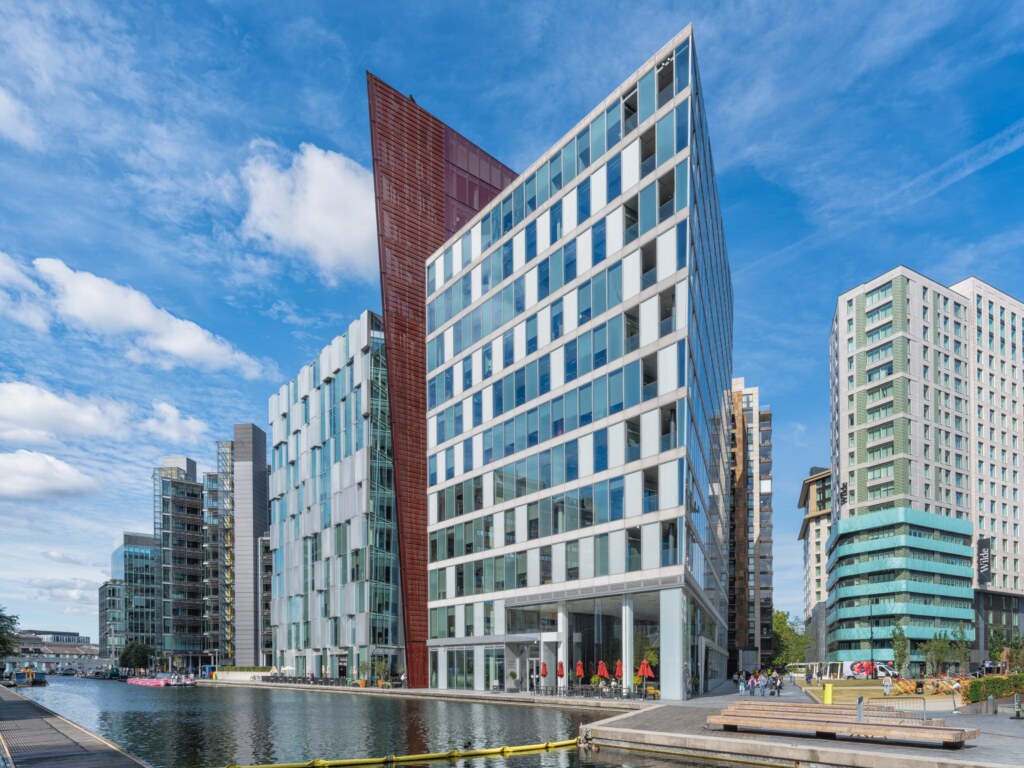
Paddington Central and Merchant Square offer the canal-side campus experience that’s Paddington’s most distinctive workplace proposition. Centred on Sheldon Square, British Land’s 11-acre Paddington Central campus provides a managed environment with shared amenity and an outdoor events programme. Not to mention building stock that has been progressively upgraded through retrofit. These buildings suit larger occupiers that want a headquarters position in a managed, well-connected campus.
-
-
Established buildings being upgraded
Several Paddington buildings completed in the early 2000s are undergoing (or have recently completed) significant sustainability upgrades. That includes electrification, improved end-of-trip facilities, new balconies and terraces, EPC improvements and BREEAM reassessment.
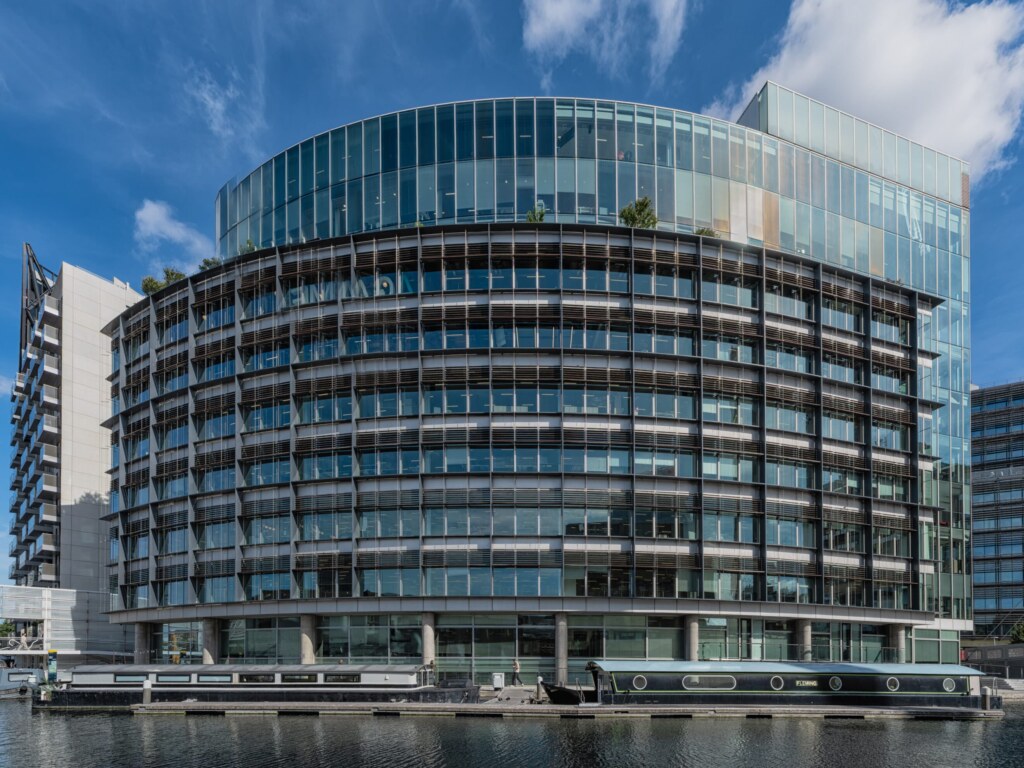
The Point and One Kingdom Street are both in this category, offering the established Paddington location alongside an improving specification. This is a strong option for businesses that want a proven, well-connected address without paying the premium of the newest buildings.
-
-
Managed and flexible workspace
Paddington has a well-developed flexible workspace offer, including WeWork at 5 Merchant Square and serviced space within several campus buildings. This is ideal for businesses testing a Paddington address, Thames Valley businesses establishing a London presence or those with variable headcount.
-
-
5 office buildings in Paddington
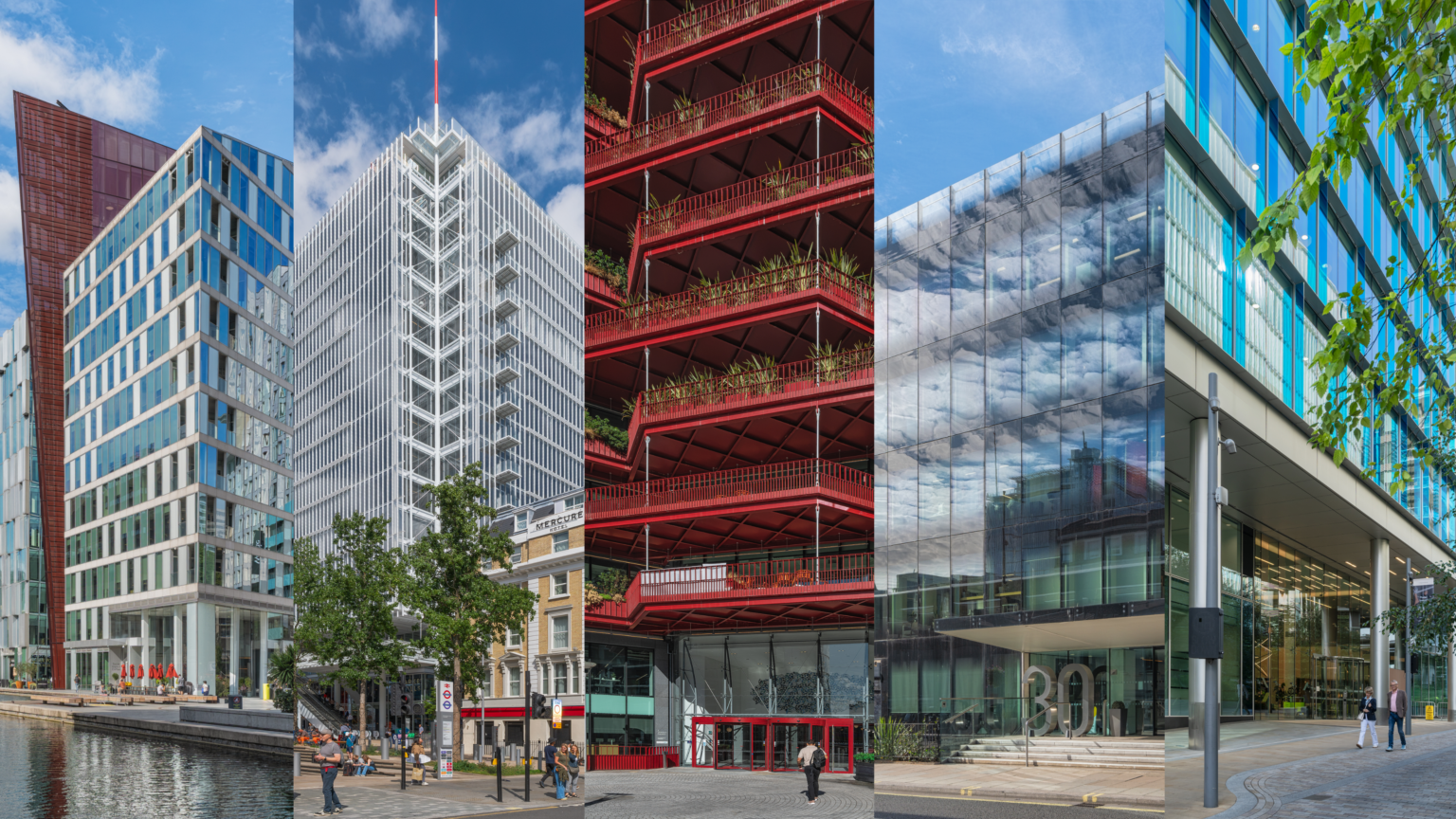
Paddington’s office stock tells a clear story: a first generation of purpose-built canal-side buildings from the early 2000s, now being comprehensively upgraded for the next generation of occupiers.
The buildings below illustrate both the original ambition of the Paddington Basin regeneration and the retrofit investment that is reshaping what those buildings offer today.
-
1) 30 Eastbourne Terrace
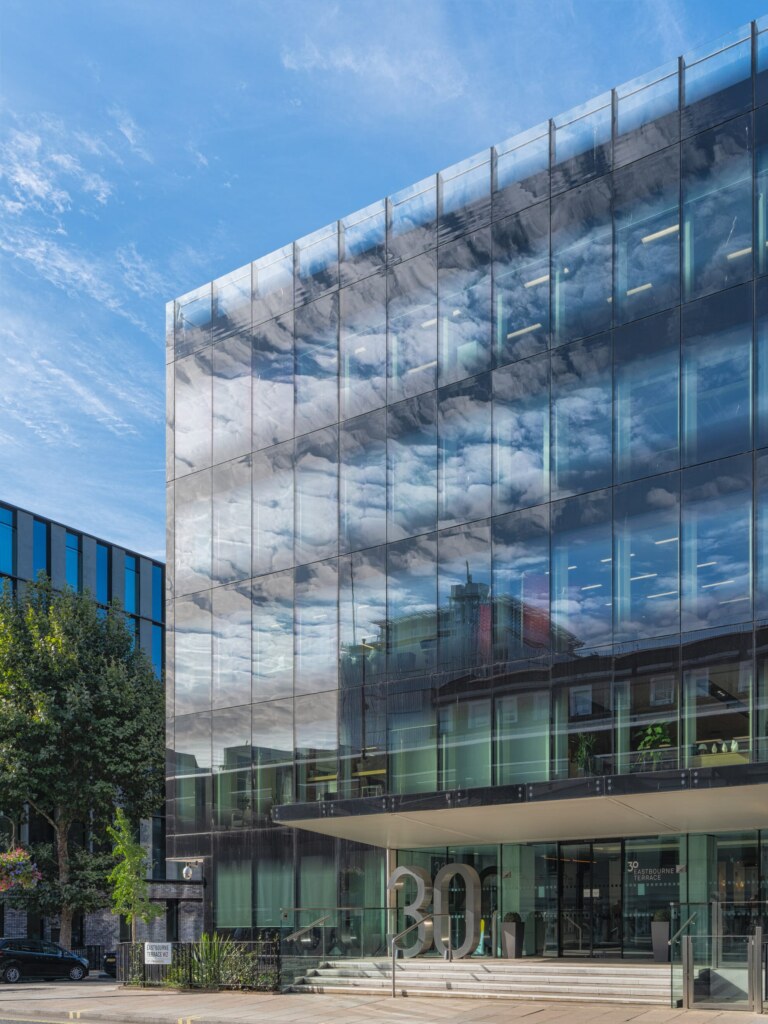
30 Eastbourne Terrace is part of Landsec’s Eastbourne Terrace campus – a pair of refurbished Grade A office buildings on the south side of Paddington station, directly opposite the Elizabeth line entrance. It offers around 57,000 sq ft across four floors, designed by Fletcher Priest Architects as part of a wider programme that’s transformed a row of ageing offices into a contemporary, sustainably operated campus. The building is powered by 100% renewable electricity and holds a BREEAM Excellent rating.
The defining characteristic is its position. Paddington station is directly across the road. That puts the Elizabeth line, Heathrow Express, Great Western Railway and four Underground lines on your doorstep. Occupiers also have access to the café and communal roof terrace at 20 Eastbourne Terrace next door, and the East-West Cycle Superhighway runs immediately behind the building. Heathrow is 25 minutes by Elizabeth line and 28 minutes by Heathrow Express.
Key facts
- Size: c. 57,000 sq ft NIA
- Floors: 4
- Developer / Owner: Landsec
- Architect: Fletcher Priest Architects
- Lease type: Traditional leasehold
- Accreditations: BREEAM Excellent, 100% renewable electricity
- Location: Directly opposite Paddington Elizabeth line entrance, W2 6LE
-
-
The appeal of 30 Eastbourne Terrace
- The closest office building to Paddington’s Elizabeth line entrance – putting Heathrow 25 minutes away, Canary Wharf 17 minutes and Liverpool Street around 12 minutes from the front door
- 100% renewable electricity and BREEAM Excellent credentials in a comprehensively refurbished building, ideal for occupiers with operational net zero or ESG reporting requirements
- Access to the café and communal roof terrace at 20 Eastbourne Terrace, alongside 50 cycle spaces, showers and changing facilities, and direct access to the East-West Cycle Superhighway
- Flexible floorplates across four floors, with fully fitted and furnished space available for businesses that want to be operational quickly without a fit-out programme
Occupiers
30 Eastbourne Terrace attracts businesses who prioritise the station connection. We’re talking about those with teams regularly travelling to Heathrow or the Thames Valley and professional services businesses that need to be accessible to clients across London
With floorplates of around 14,000 sq ft, the building’s four-floor configuration suits businesses of 80 to 120 people who want their own level in a building that puts the whole of London’s transport network a short walk away.
Features
The Eastbourne Terrace campus model works by two buildings sharing amenity – a practical solution to the challenge of providing a full workplace offer in a relatively modest building.
Rather than trying to pack a gym, cafe, terraces and end-of-trip facilities into 57,000 sq ft, 30 Eastbourne Terrace draws on the shared infrastructure next door. For occupiers, that means the amenity of a larger building without the scale commitment. The roof terrace at 20 Eastbourne Terrace has views over Paddington station and west London, so it’s the kind of space that actually gets used.
-
2) One Kingdom Street
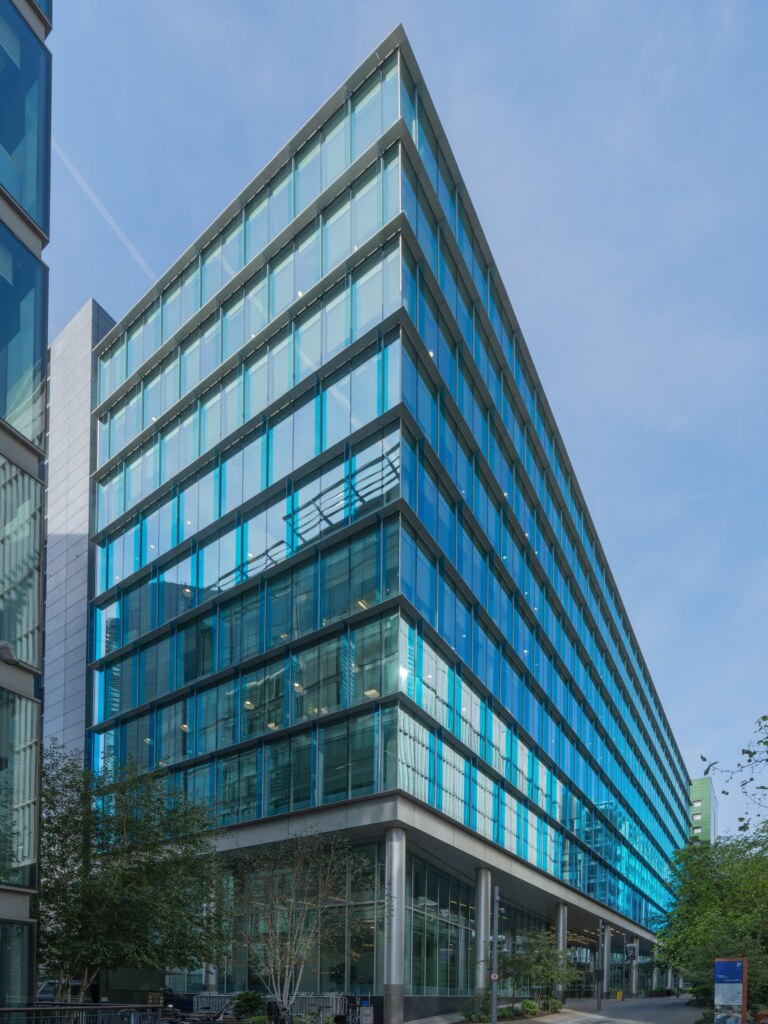
One Kingdom Street is one of Paddington Central’s landmark buildings. The 265,000 sq ft, nine-floor Grade A office building was completed in 2008 at the heart of British Land’s 11-acre campus. It’s distinguished by its vertical glass fins on the principal façades with a 3,000 sq ft double-height entrance hall and twin atria that bring natural light into every floor. Levels 1, 2 and 6 have been refurbished with new Cat A specification and improved ESG credentials, and the building is 71% leased to major multinational tenants.
One Kingdom Street sits at the north end of the Paddington Central campus, looking out over Sheldon Square’s public realm and connected to the wider estate’s amenity offer. That includes cafes, restaurants, a gym and an outdoor events programme. Paddington station is a five-minute walk while Oxford Street and the West End are 15 minutes away and Heathrow is 15 minutes by Heathrow Express.
Key facts
- Size: 265,000 sq ft NIA
- Floors: 9
- Completed: 2008
- Architect: Sheppard Robson
- Owner: CC Land Holdings
- Lease type: Traditional leasehold (Cat A and Cat A+ available on refurbished floors)
- Location: Paddington Central campus, W2 6BD
-
-
The appeal of One Kingdom Street
- 265,000 sq ft across nine floors with typical floorplates of around 30,000 sq ft – one of the largest single-floor options at Paddington Central, suited to businesses that want significant scale in a managed campus environment
- Vertical glass fins and twin atria that provide strong natural light across all floors, creating a working environment that the building’s marketing rightly describes as generous and open
- Refurbished floors at Cat A and Cat A+ standard available now, with improved ESG credentials – allowing occupiers to access a well-established Paddington address in space that meets current specification expectations
- Full access to Paddington Central’s campus amenity: Sheldon Square’s cafes, restaurants and gym, the outdoor events programme and the canal-side public realm that makes this part of W2 so pleasant to work in
Occupiers
One Kingdom Street’s established tenant base reflects the breadth of Paddington Central’s occupier community. Vodafone and Statoil (now Equinor) were early anchors, establishing the building’s credentials as a serious corporate headquarters address. The building is currently 71% leased, with refurbished floors available. This combination gives incoming occupiers the reassurance of established occupancy and the benefit of recently upgraded space. Sitting 15 minutes from Heathrow and with Great Western Railway services available from the station, the building has consistently attracted businesses with significant Thames Valley and international connections.
Features
The campus context is One Kingdom Street’s most important practical differentiator from a standalone building. Being part of British Land’s Paddington Central means access to managed public realm, a shared events programme, a diverse food and leisure offer at Sheldon Square, and a landlord with a long-term investment in the quality of the surrounding environment. If you’re deciding between a standalone building in W2 and a campus position, that managed environment reduces the day-to-day management burden and gives the workplace a character that individual buildings rarely achieve on their own.
-
3) 3 Sheldon Square
3 Sheldon Square is the clearest example of what retrofit can deliver in Paddington. British Land’s 140,000 sq ft, 12-storey building at the heart of Paddington Central was comprehensively refurbished in 2024, retaining the original structure while delivering an all-electric building. That includes air source heat pumps, a 40% reduction in operational energy demand, EPC A, BREEAM Excellent and an embodied carbon intensity of just 124 kgCO2e/m² – a figure that competes with best-practice new builds.
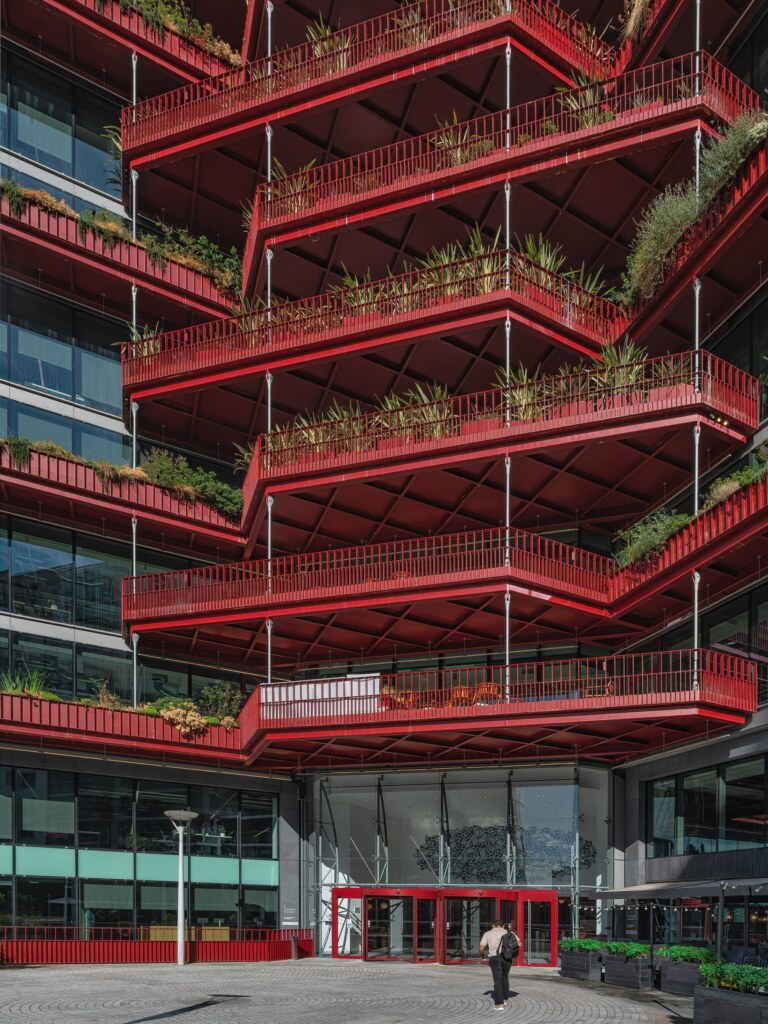
The refurbishment added new balconies to most floors overlooking Sheldon Square with a new 4,300 sq ft reception and end-of-trip facilities, plus Cat A office floors with improved specification throughout. Virgin Media O2 took 83,000 sq ft across seven floors as its new headquarters, completing in early 2024. The building is now 65% let, with further availability under offer at the time of writing.
Key facts
- Size: 140,000 sq ft NIA
- Floors: 12
- Refurbished: 2024
- Developer / Owner: British Land
- Lease type: Traditional leasehold
- Accreditations: BREEAM Excellent, EPC A, Net Zero targeted, all-electric
- Embodied carbon: 124 kgCO2e/m² – below new-build benchmarks
- Location: Paddington Central campus, W2 6HY
-
-
The appeal of 3 Sheldon Square
- An all-electric building with EPC A, BREEAM Excellent and an embodied carbon intensity of 124 kgCO2e/m². These sustainability credentials have been delivered through retrofit, reducing both operational and construction carbon
- New balconies on most floors overlooking Sheldon Square’s public realm, a new reception and comprehensive end-of-trip facilities. The building has essentially been reset to current occupier expectations
- Virgin Media O2’s 83,000 sq ft headquarters commitment on a multi-year lease is the strongest endorsement available. A major occupier choosing a refurbished campus building over new build reflects the quality of what’s been delivered
- Operational energy demand reduced by over 40% versus the pre-refurbishment building, creating meaningful running cost savings for occupiers alongside the environmental benefit
Occupiers
Virgin Media O2’s decision to make 3 Sheldon Square its new headquarters is the defining leasing event in the building’s post-refurbishment life. Their choice to consolidate teams from multiple locations reflects both the quality of the refurbished space and the practical advantage of Paddington’s Great Western Railway connections to its Reading site. The building’s remaining floors attract businesses that want the campus environment and the sustainability credentials at a rent point that reflects the building’s refurbished status.
Features
The balcony strategy at 3 Sheldon Square is the refurbishment’s most visible intervention. Rather than treating external amenity as a rooftop-only feature, the design team added a new balcony structure to the front elevation, giving every floor access to outdoor space overlooking Sheldon Square.
The balconies improve both the thermal performance and the daily experience of the building. That’s combined with a brise soleil system that manages heat gain through the glazed surfaces and is planted with greenery. The result is a building where sustainability investment is visible from inside and outside the workplace.
-
4) 5 Merchant Square
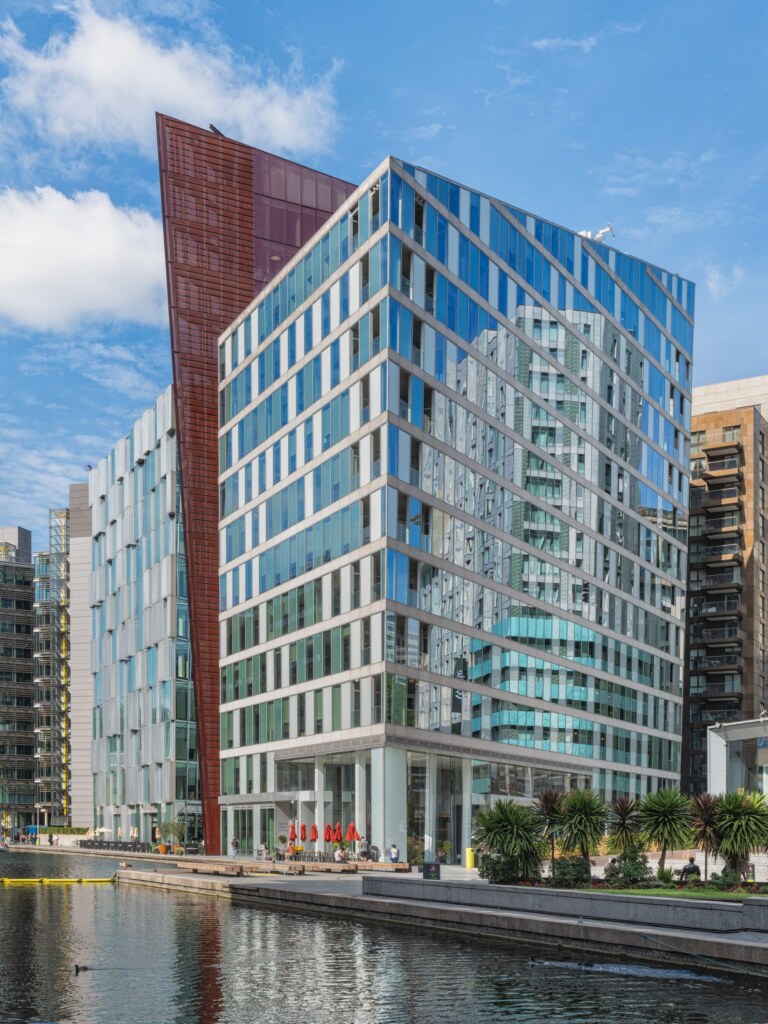
5 Merchant Square is the most distinctive building in Paddington Basin. Completed in 2013, the 262,000 sq ft, 15-floor Grade A building rises at the western edge of the basin with a striking triangular façade that faces the canal, the existing Paddington Central buildings and a new public square. A 15-storey full-height atrium draws natural light into the heart of the building, and each corner floor has a private terrace. So, occupiers on every level have access to outdoor space with views across the canal and west London.
The building is at the heart of the Merchant Square mixed-use development, which adds cafes, restaurants, a street food market and canal-side events to the immediate environment. WeWork operates managed workspace on the top four floors. Paddington station is four minutes on foot. Up to 45,000 sq ft of Cat A space is currently available on floors 8 and 9.
Key facts
- Size: 262,000 sq ft NIA
- Floors: 15
- Completed: 2013
- Architect: mossessian architecture
- Lease type: Traditional leasehold (Cat A available) and managed (WeWork, top 4 floors)
- Accreditations: BREEAM Excellent, 227 covered cycle spaces
- Location: Merchant Square, W2 1JZ – canal-side, four minutes from Paddington station
-
-
The appeal of 5 Merchant Square
- A full-height 15-storey atrium and private corner terraces on every floor. This architectural commitment to natural light and outdoor access is unusual in a building of this scale
- The most prominent canal-side position in Paddington Basin, with views across the Grand Union Canal and west London that no Eastbourne Terrace or Sheldon Square building can match
- WeWork’s presence on the top four floors provides a managed option within the building, giving businesses a route to a Merchant Square address before committing to a traditional lease
- 45,000 sq ft of Cat A space available on floors 8 and 9, each offering 22,879 sq ft of open-plan workspace with four private terraces per floor. Certainly one of the more substantial current opportunities in Paddington
Occupiers
Marks & Spencer’s UK headquarters at 5 Merchant Square is the building’s anchor and the best single illustration of why Paddington appeals to large UK businesses with national operations. The Elizabeth line and Great Western Railway connections make the building accessible to a workforce spread across London and the South East, while the station proximity keeps Heathrow within easy reach for a business with extensive international supply chain relationships.
WeWork’s presence on the upper floors creates a visible mixed-tenure community that suits the building’s position at the convergence of the traditional leasehold and flexible workspace markets.
Features
The triangular plan form that gives 5 Merchant Square its distinctive façade also solves a practical design problem. The site has three distinct edges in the existing buildings to the west, the canal and a new public square to the east. The triangular geometry means the building responds to all three. No elevation feels like the back of the building.
The result is a building that works well from every approach angle. It enlivens the canal frontage without dominating it and creates a new public square at its base to activate the eastern part of the Basin. The corner terraces are the practical dividend of that geometry. In a rectangular building, corners are often wasted. But here, they become the building’s most sought-after spaces.
-
5) The Point, 37 North Wharf Road
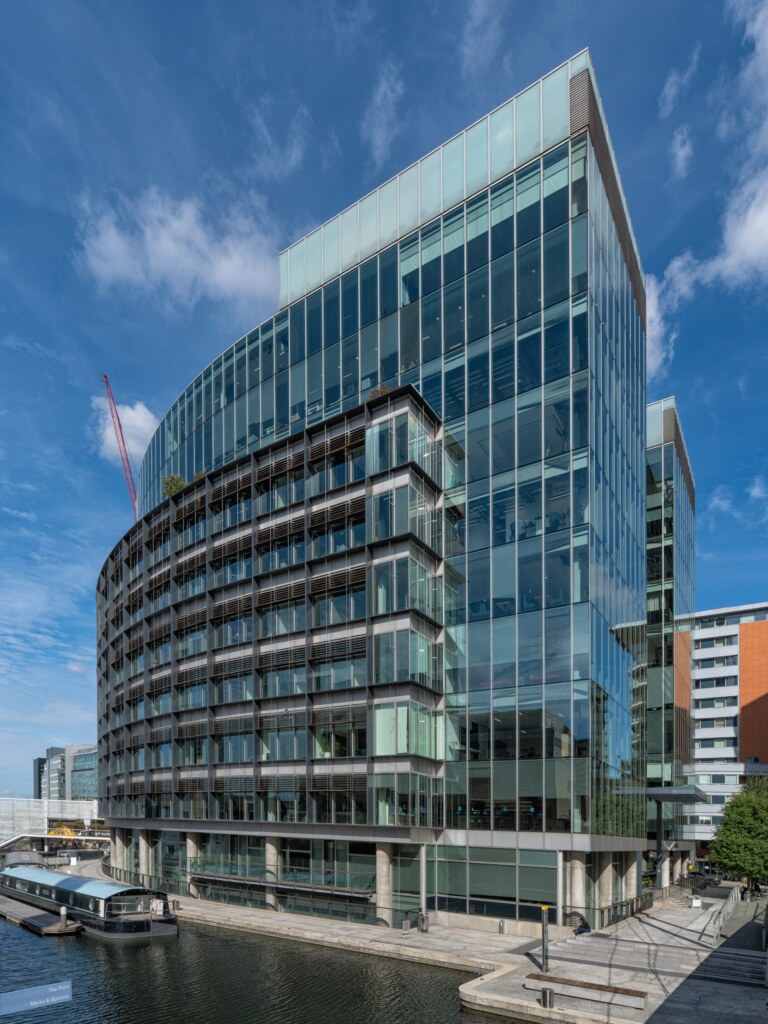
The Point was one of the first buildings to set the tone for the Paddington Basin regeneration. Completed in 2003, the 233,000 sq ft building at 37 North Wharf Road takes its name and form from its position at the tip of the basin. A ship’s prow-shaped façade follows the curvature of the Grand Union Canal, with a 10-storey internal glass atrium that brings natural light down through the full height of the building.
The building has been progressively upgraded over the past several years, most recently with the installation of air source heat pumps making it fully electric with all energy from renewable sources. A new communal roof terrace, a refurbished reception and an on-site gym we all added too. Refurbished Cat A floors are available with floor-to-ceiling heights of 3.45m. BREEAM Excellent and EPC B reflect the substantial improvements without the carbon cost of demolition and rebuild.
Key facts
- Size: c. 233,500 sq ft NIA
- Floors: Ground plus 9 upper floors
- Completed: 2003 (ongoing refurbishment)
- Architect: Sir Terry Farrell and Partners
- Lease type: Traditional leasehold (refurbished Cat A floors available)
- Accreditations: BREEAM Excellent, EPC B, WiredScore Gold, fully electric, 100% renewable energy
- Location: 37 North Wharf Road, W2 1AF – canal-side, five minutes from Paddington station
-
-
The appeal of The Point
- Fully electric with all energy from renewable sources, BREEAM Excellent and EPC B. The building’s sustainability upgrade was delivered through operational improvement rather than demolition, with WiredScore Gold digital infrastructure to match
- Refurbished Cat A floors with 3.45m floor-to-ceiling heights. That’s notably generous for a 2003 building and a practical advantage for fit-out designs that want to make the most of exposed services or ceiling-height feature elements
- An on-site gym private to building occupiers, a communal roof terrace with sweeping views and a 7th floor wraparound private terrace on available space. The building’s amenity offer has been methodically upgraded
- Terry Farrell’s prow-shaped façade and the 10-storey atrium give the building an architectural identity that most 2003-vintage office buildings in London lack. Above all, its presence on the Basin makes it immediately recognisable
Occupiers
The Point was originally commissioned as the UK headquarters for Orange Telecommunications, housing over 2,100 staff. This commitment established the Basin as a serious corporate address at a time when Paddington’s regeneration was still unproven.
Mitsubishi Hitachi Power Systems Europe moved from Mayfair to The Point, reflecting the building’s ability to attract businesses who value transport connections and building quality as much as their previous prestigious postcode. The ongoing refurbishment has maintained the building’s competitiveness against newer stock too, and several Paddington buildings are now following that pattern.
Features
The ship’s prow form is more than an architectural gesture. The curvature of the façade follows the line of the canal, giving the building a direct visual relationship with the waterway that rectangular buildings set back from the water can’t achieve.
From the basin, The Point reads as part of the canal landscape rather than an office block placed beside it. Inside, that relationship translates into canal views from floors that would otherwise look onto a service road. The curvature of the building also creates a sheltered wraparound terrace on the 7th floor, with views in three directions.
It’s the kind of architectural detail that takes on a different quality when you’re actually in the building rather than reading about it.
-
Key considerations
Paddington’s case as an office location has strengthened considerably with the arrival of the Elizabeth line. The combination of airport access and national rail connections with an improving campus environment has attracted a more diverse occupier base. Alongside active retrofit investment across the estate, it’s raised the overall quality of the building stock. But there are practical considerations worth understanding before shortlisting buildings.
Heathrow connectivity is Paddington’s clearest differentiator
No other central London office submarket can match Paddington’s airport access. Heathrow Express at 15 minutes and the Elizabeth line at 25 minutes are facts that affect how a business operates every day, particularly if you have international clients, senior teams that travel regularly or operations that span the UK and continental Europe. If that connectivity matters to how your business runs, it’s worth paying the Paddington premium over a comparable building in Clerkenwell or Holborn.
The two campus settings offer different trade-offs
Eastbourne Terrace and the station-side buildings prioritise transport convenience. Paddington Central and Merchant Square prioritise the canal-side environment and the managed campus experience. Both are within a five-minute walk of the station, but the working environment they offer is so different. Businesses that entertain clients or whose culture is strongly shaped by the working environment will generally find the campus setting more suitable. Those whose primary requirement is transport efficiency might prefer the station-side buildings.
-
Office space calculator
Paddington offers everything from large headquarters floors to smaller managed offices. Use Oktra’s Office Space Calculator to turn your headcount and workplace needs into a practical space requirement before you start viewing.
Try it out -


-
Retrofit is reshaping what established buildings can offer
3 Sheldon Square, The Point and One Kingdom Street all demonstrate that the right retrofit investment can bring a 2000s-era building to a specification that competes with new builds on sustainability credentials and occupier experience. For businesses with strong ESG commitments, a refurbished Paddington building could offer better embodied carbon credentials than a new build elsewhere, at rents that reflect the building’s age rather than its improved specification.
Rents are competitive with the West End for equivalent specification
Grade A rents at Paddington typically run from £70 to £90/sq ft, putting it below Mayfair, Soho and the City’s newest towers while offering comparable or better transport connectivity. If you want central London quality without central London pricing, Paddington’s combination of the Elizabeth line, Heathrow Express and the Thames Valley connections makes it one of the more compelling cases in the current market. A full cost comparison is available in Oktra’s London cost guide.
-
Paddington’s exceptional transport links and modern office stock come at a price. Oktra’s London Office Rent Report shows what businesses can expect to pay across the capital, giving you the rental benchmarks you need to assess whether Paddington delivers the right value for your requirements.
Download now -
-
Alternative areas to Paddington for office space
15 minutes east by District line, Hammersmith offers a west London alternative with a well-established corporate occupier base, plus lower rents than Paddington and strong road access via the A4 and M4 corridor. It’s worth considering for businesses that need west London access without the Paddington premium.
White City and Shepherd’s Bush are emerging as a technology and media cluster. The BBC’s headquarters, ITV Studios, Imperial College’s White City campus and several major technology businesses have anchored here. It’s more creative in character than Paddington, with Elizabeth line access and lower rents.
The City of London offers a more formal corporate address for businesses whose clients are concentrated in the financial services sector. It’s better for EC2 and EC3 adjacency, but less practical for businesses with significant Heathrow or Thames Valley connections.
20 minutes south-east, Victoria shares Paddington’s mainline rail credentials, with Gatwick Express as its equivalent of Heathrow Express. It has the advantage of Westminster proximity for businesses that need government adjacency alongside transport connectivity.
Not settled on a location? Oktra’s London area guide compares the main submarkets by sector, character and cost.
-
-
Paddington office space FAQs
-
 What kind of businesses are based in Paddington?
Paddington has traditionally attracted large corporate occupiers. Marks & Spencer, Vodafone, Virgin Media O2 and AstraZeneca are among the businesses that have based significant UK operations here. The common thread is organisations that need strong national and international transport connectivity alongside a high-quality central London address. Technology businesses, pharmaceutical companies, professional services firms and financial services organisations have all grown their Paddington presence, drawn by the Elizabeth line’s extended catchment and the improving campus environment.
How much does office space in Paddington cost?
Headline rents for Grade A space in Paddington typically run from £70 to £90/sq ft, depending on building quality and specification. Refurbished buildings like 3 Sheldon Square and The Point offer competitive rents relative to their specification, while newer or more prominently positioned buildings command the top of the range. A full cost overview is available in Oktra’s London cost guide.
How does Paddington compare to the West End for transport?
Paddington’s transport offer is stronger than most West End locations for international and national travel. Heathrow is 15 minutes by Heathrow Express and 25 minutes by Elizabeth line, which is significantly faster than from Mayfair, Soho or Holborn. Great Western Railway services to Reading, Bristol and Cardiff give Paddington a national connectivity that no other central London submarket matches. The Elizabeth line has extended the eastward catchment significantly, putting the City and Canary Wharf within practical commuting distance.
What are the two main office settings in Paddington?
Eastbourne Terrace, on the south side of the station, prioritises transport convenience. Buildings here are directly opposite the Elizabeth line entrance and suit businesses whose people are constantly in transit. Paddington Central and Merchant Square, a five-minute walk north, offer a canal-side campus setting with restaurants, a public amphitheatre, a gym and managed public realm. Both settings are within easy walking distance of the station, but they offer different working environments and suit different kinds of businesses.
Is there flexible or managed office space in Paddington?
Yes. WeWork operates managed workspace on the top four floors of 5 Merchant Square, providing flexible terms for businesses that want a Paddington address without committing to a traditional lease. Several buildings at Paddington Central also offer Cat A+ fitted suites that reduce the fit-out commitment for incoming tenants. Managed and flexible options are available at a range of sizes, from small teams to full floors.
-
 What kind of businesses are based in Paddington?
-
Contact us
Get in touch to discuss your potential office space costs
020 7553 9500
info@oktra.co.uk
-
"*" indicates required fields
Related content
-
Want updates on similar new content? We’ll send you an email a month with new insights when you join our mailing list.
JOIN THE LIST
