

Share

min read

Senior Content Manager
Content specialist in office design and build.
-
Artificial intelligence is changing the way businesses work. But in London, it’s also starting to change where they work too, with the industry becoming a significant part of the capital’s technology occupier market.
And, as these businesses attract investment and expand their teams, many are finding that their property requirements are evolving. Some are still making use of the flexibility offered by serviced offices and coworking spaces, while others are now taking substantial conventional offices and establishing permanent headquarters.
This is creating a new office market story for London. On the face of it, AI companies are taking more space. But dig a little deeper and you’ll see how their growth is influencing where they locate and the type of buildings they choose, not to mention what they expect their workplace to achieve.
-
AI is becoming a significant London occupier story
The scale of AI’s growth is becoming increasingly visible in London’s office market. CBRE research shows that AI businesses accounted for 34% of Central London technology office take-up in 2025, compared with just 4% of technology leasing in 2015. In that same decade, AI-led companies have taken around 1.5 million sq ft of traditional office space across Central London.
The trajectory could become even more significant. CBRE estimates that AI-driven demand could reach 4 million sq ft by 2033. For context, that’s almost 1.5% of London’s total office stock (283m sq ft, according to Statista), in a relatively short space of time. Put simply, AI could gradually become an important source of office demand over the coming years.
-

-
Crucially, this is happening within a technology ecosystem that’s already established. London combines major universities and research institutions with international investment. That’s bolstered by specialist talent and an extensive network of technology businesses. It also attracted 67% of all UK-based venture capital rounds raised by AI startups in 2025, according to Dealroom.
The implications are becoming harder to ignore for both property owners and workplace decision-makers. AI used to be a subset of the technology market. Now, it’s becoming an occupier group with its own growth patterns and distinctive workplace requirements.
-
-
Where London’s AI businesses are clustering and why
As you might expect, AI companies aren’t distributed evenly across London. Their locations reflect similar factors that have historically attracted technology businesses:
- Access to talent
- Transport
- Investment
- Research
- An established business community
King’s Cross is particularly significant. The wider Knowledge Quarter brings together universities and research organisations alongside technology businesses. The likes of Google DeepMind, Scale AI, Meta, OpenAI and Wayve have established a presence in or around the area, which stretches through Euston and Bloomsbury as well as King’s Cross.
-
Old Street and Shoreditch offer a distinct but complementary proposition with an established technology and start-up identity. That’s bolstered by a dense network of businesses and connections that can be attractive to earlier-stage and scaling companies.
Canary Wharf provides another model. With large floorplates in high-quality buildings and a growing technology community, there’s clear capacity for businesses that are moving beyond smaller premises.
-

-
The wider pattern goes beyond these established clusters though. Locations broadly follow major transport networks with an east-to-west pattern that reflects the importance of accessibility. Future activity could also emerge around innovation districts such as Stratford and White City.
Above all, growing AI businesses are looking for more than just locations. They want access to the ecosystems around them too.
-

-
From flex space to permanent HQ
The journey from start-up to established occupier can happen remarkably quickly in AI.
As in lots of sectors, flexible workspace makes sense during the early stages. It provides a professional environment without requiring a long-term commitment. All while giving businesses access to meeting rooms and shared amenities, plus the ability to expand or contract as headcount changes.
The numbers demonstrate just how important this model has become. In a CBRE sample of 100 London-based AI startups, 75 were occupying flexible office space. That’s compared to just nine in traditional office space and 16 with no Central London office presence.
Related: 7 Workplace Priorities for Fast-Growing AI Companies
-
Flex is a stepping stone rather than the destination
As teams grow, the limitations of shared space can become more apparent. Companies might need:
- Greater control over their environment
- More room for collaboration
- Dedicated areas for focused technical work
- Stronger security
- A workplace that expresses their identity to employees and clients
-
-
Across London, AI companies are moving from flexible space into traditional offices at an unusually rapid rate. Take OpenAI, for example, which began its London operation at Fora’s York House in King’s Cross. It subsequently signed for just under 100,000 sq ft of traditional space at Jahn Court, also in King’s Cross.
Similarly, Synthesia has taken 19,500 sq ft at 20 Triton Street, while Quantexa acquired around 52,300 sq ft for a new global headquarters at The Delft.
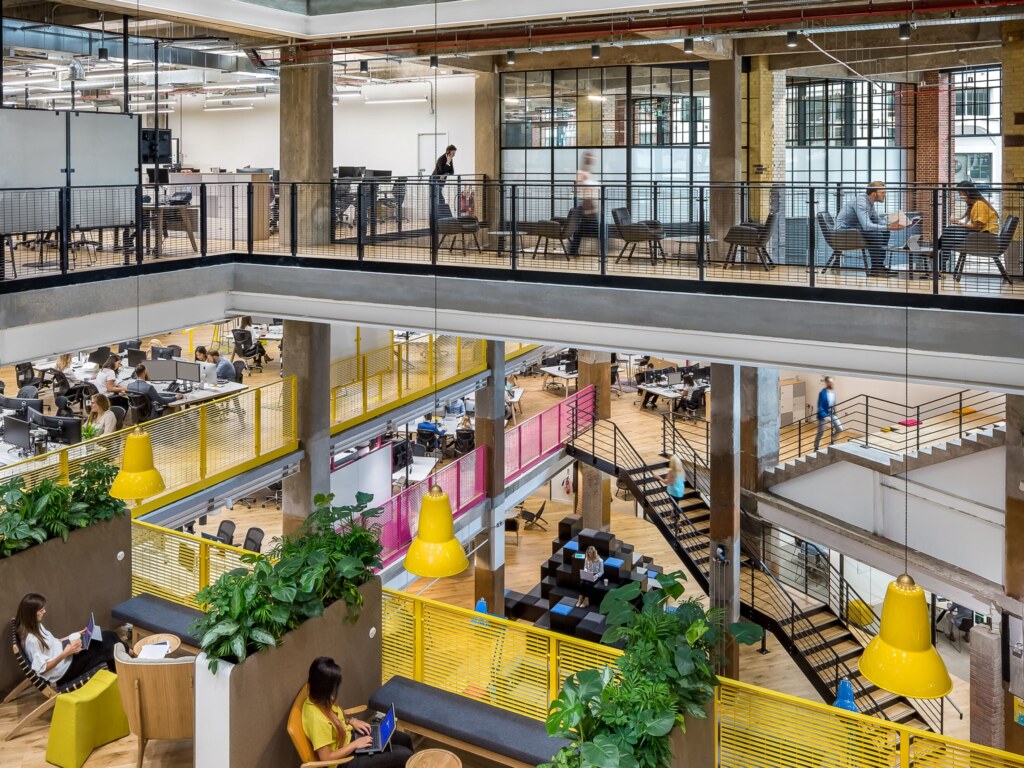
This may seem like they’re shifting away from flexibility. In fact, the flexibility is typically moving indoors. It’s built into the fit-out itself through adaptable floorplates and reconfigurable space.
-
-
What AI businesses expect from their workplace
Moving into a permanent office changes the question from ‘where can we work?’ to ‘what does our workplace need to do?’
In truth, there’s rarely a single answer for rapidly growing AI businesses. Different teams can have very different working requirements. For example:
- Engineers and technical teams might need periods of concentrated work
- Product, commercial and leadership teams could spend more time collaborating
- Research and development often require project spaces
- Growing businesses also need places for learning and social connection
The workplace needs to accommodate these different modes of work without becoming overly rigid. Below, we’ll look at some of the ways to achieve that…
-
Flexibility built around growth
AI companies can change quickly. That could be a significant headcount change between funding rounds or new functions emerging as products mature.
Either way, a workplace designed around today’s organisational chart can quickly become outdated. More adaptable planning allows businesses to accommodate change without repeatedly starting from scratch.
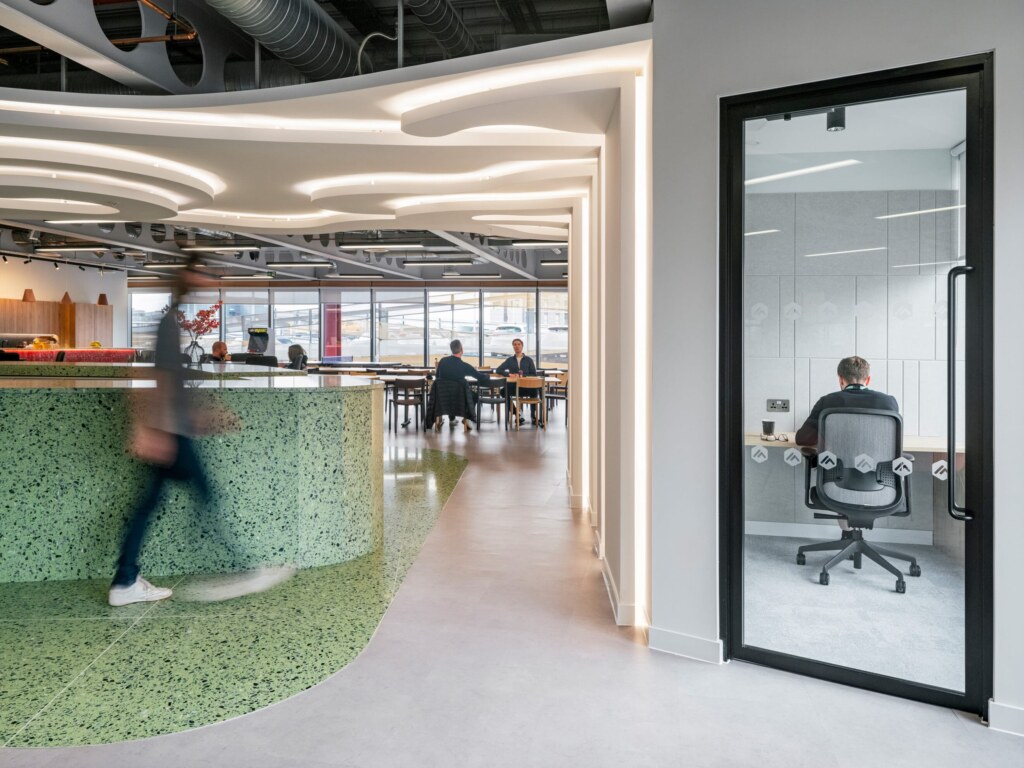
Flexible neighbourhoods and multipurpose settings are two popular options, along with layouts that can be reconfigured as teams grow.
These are all variations on the same idea, of course: designing to adapt. Within this, the real skill is knowing what should stay fixed and what needs room to change.
-
-
Collaboration without sacrificing focus
AI businesses need both sides of the workplace equation: collaboration and concentration.
Innovation depends on bringing people together, whether it’s for product development, problem-solving, demonstrations or strategic decision-making. But collaborative environments can’t simply replace spaces for concentration.
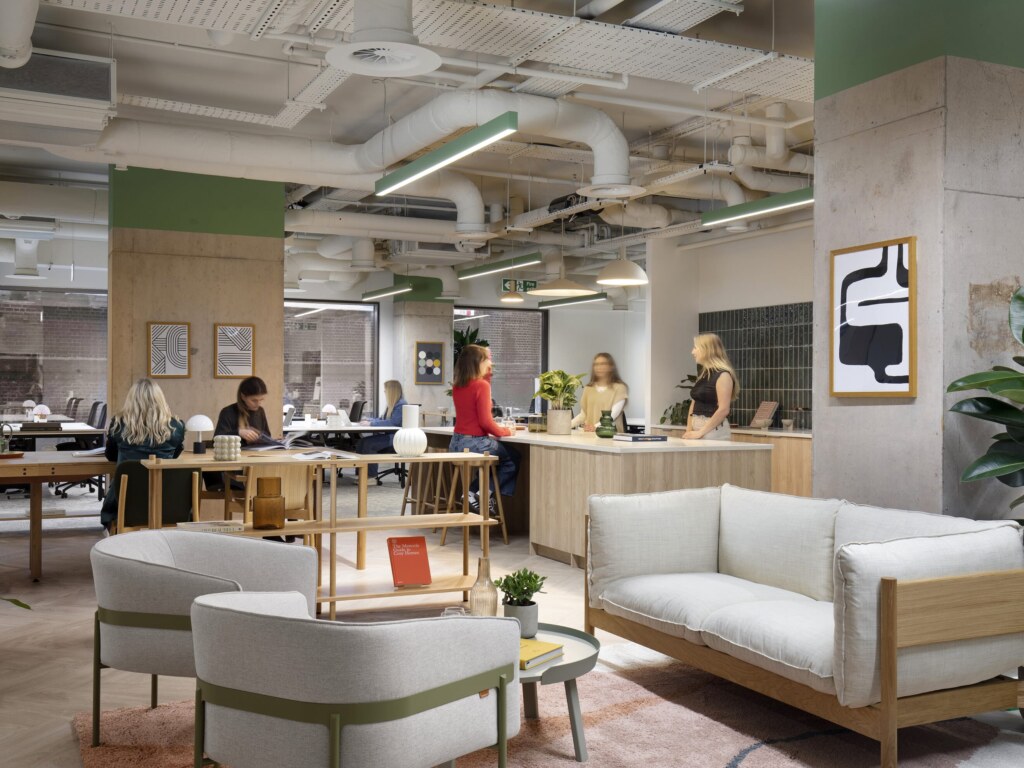
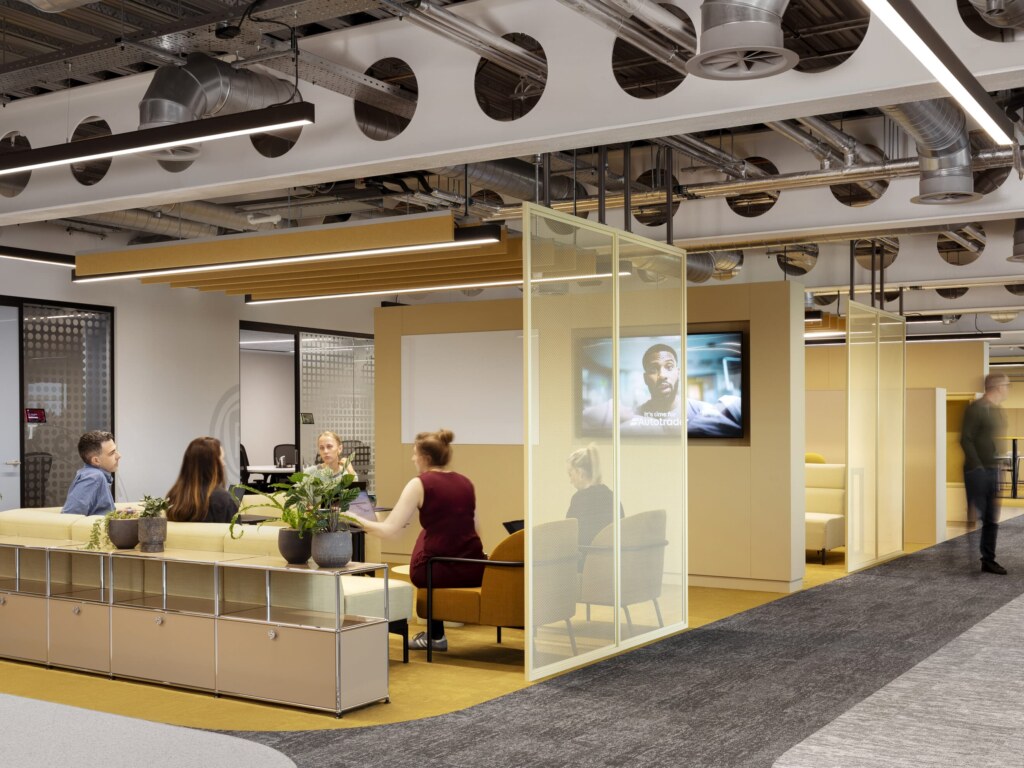
A successful workplace gives people a choice of environments, so they can move between focused work, informal conversations, structured meetings and collaborative project work.
This is particularly important in hybrid working environments. If people are making a deliberate journey into the office, the workplace needs to provide experiences and capabilities that can’t be replicated remotely.
-
-
A workplace that attracts talent
People are a critical part of the growth equation for any AI company. When you’re competing for specialist talent, the workplace is a staple of the employee proposition.
The workplace needs to feel considered and comfortable, but also authentic to the organisation. Hospitality, amenities, social spaces and a strong sense of identity can all contribute to that experience.
With the right approach, the office can be somewhere people want to spend time, rather than simply somewhere they’re expected to work. As a result of this, it can become a powerful tool in attracting and retaining talent.
-
What happens next?
The growth of AI is unlikely to affect London’s office market in a uniform way. Some businesses will remain small or predominantly remote. Others will grow into substantial occupiers with requirements comparable to established technology companies.
What’s already clear is that AI is becoming a meaningful source of demand. The prevalence of flexible space among early-stage companies suggests a strong pipeline of businesses. Many of which will be capable of moving into larger, more permanent premises as they mature.
-

-
Landlords could see greater demand for buildings that combine flexibility with the quality and infrastructure expected by sophisticated occupiers. On the other hand, AI businesses will need to think beyond the immediate requirement for desks and meeting rooms.
The most successful workplaces will need to accommodate growth without becoming obsolete. It’s important to support both focused and collaborative work, and create an experience that gives people a reason to come together.
That makes workplace strategy an increasingly important part of the AI company’s growth journey.
-
-
Explore the AI workplace
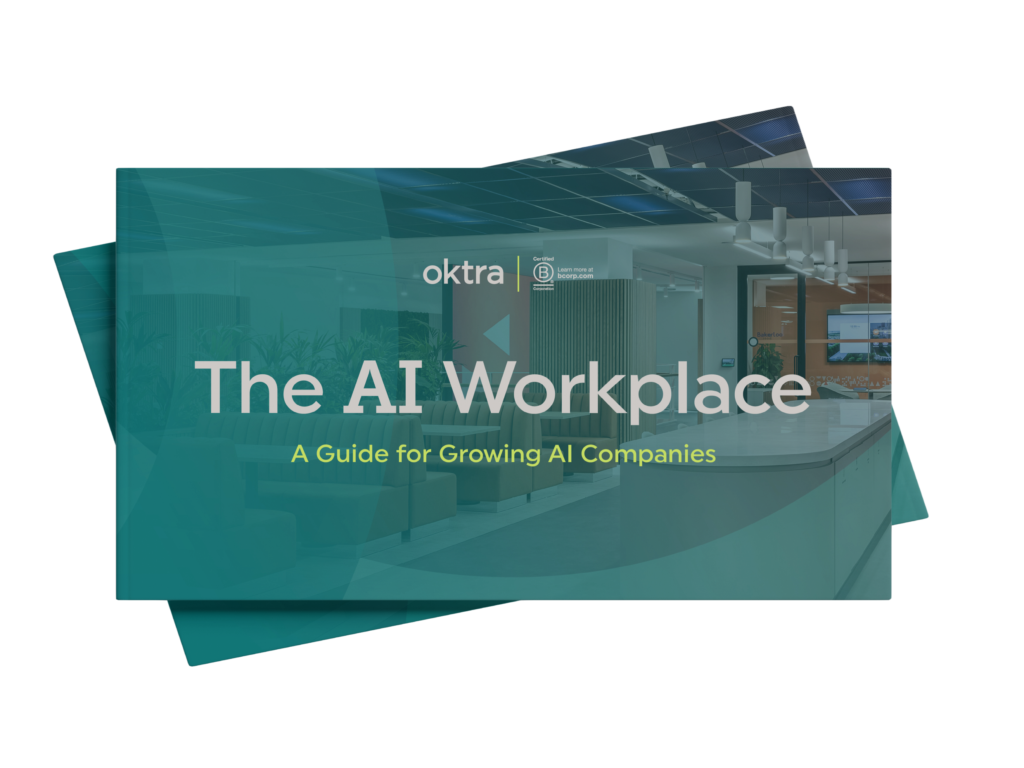
AI businesses are growing quickly, and the workplace needs to keep pace. The AI Workplace: A Guide for Growing AI Companies explores the journey from start-up to global organisation and the workplace principles that can help businesses create spaces ready for what comes next.
Download the guide -
-
Contact us
Get in touch to discuss your potential office space costs
020 7553 9500
info@oktra.co.uk
-
"*" indicates required fields
Related content

-
Want updates on similar new content? We’ll send you an email a month with new insights when you join our mailing list.
JOIN THE LIST
